for those in the neighborhood, opening on Thursday night
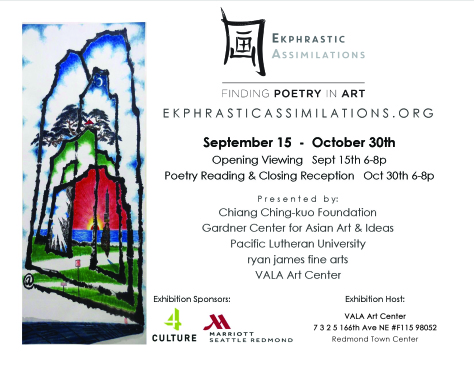
for those in the neighborhood, opening on Thursday night
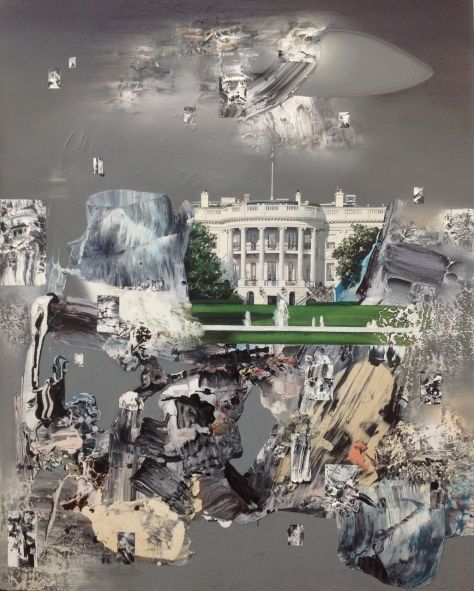
In the coming weeks I will be previewing some of the work which will be exhibited in conjunction with the Ekphrastic Assimilations — or ecphrastic, as some would prefer — project, an exhibition at the VALA art center in Redmond, WA and symposium discussion of word-image aesthetics in China and beyond jointly held by the Seattle Asian Art Museum and Pacific Lutheran University. Here, the first instance of such an exchange to be featured on this blog, namely the poem “The Grey Painting” (2016) by my colleague Rick Barot written in response to the painting “Fugue” (2014), which is below. Its important to observe that Rick did not have the title when he wrote the poem, as the titles from all of the images have been withheld so as not to complicate the poets’ responses to the images as visual, rather than verbal, expression.
At the risk of directing, or just polluting the reading process, either of the image or of Rick’s fine poem, I will just add that what fascinates me at the moment at least about reading words and images together is the question of proximity, here expressed in Rick’s line:
You are near or you are far,
depending on the accuracy of the words I have chosen.
The “you” here can be the image for which the poem is composed, or of course any other you. The problem of being apart from that “other” is in a sense the same, a longing or even a curiosity, and often an experience startlingly deep precisely for its very remoteness, like “…the plant / that you brush by in the dark of your / own house.” Words reaching across to an image are to my mind much like neurological events occurring in different parts of the brain. They are aware of one another in a sense, but still and forever distinct.
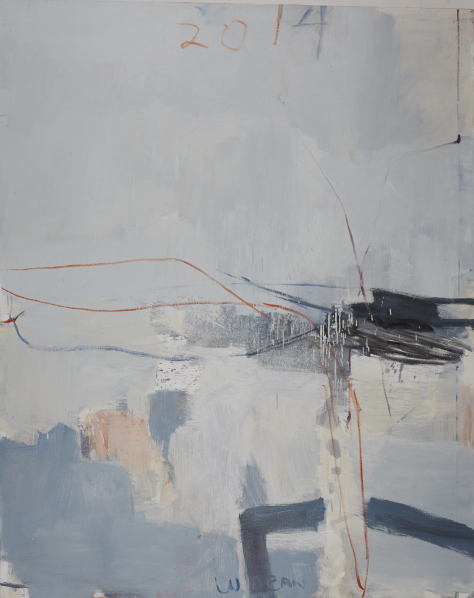
THE GRAY PAINTING
by Rick Barot
I may be looking at the gray painting
that is now in front of me, but it is you I am addressing.
You are near or you are far,
depending on the accuracy of the words I have chosen.
When my teacher told me to use this
instead of the, she was talking about the range between
the intimate and the conventional. The gray painting
is radiant, but it is a melancholy radiance.
To describe it only seems to lean away
from what I intend. Maybe, then, touch is a better way
of explaining the pleasure of that
encounter: the surprise and familiarity of the plant
that you brush past in the dark of your
own house. Or maybe the always-new logic of a dream
is closer to the truth: the falling that takes place
in a place where there is no ground. The gray painting
is there for me, a parcel with its warren
of successful rooms. One door opening to foggy roses.
Another one opening to a dawn that is the color of tea.
Surely there will always be new language
to tell you who I am, imagination rousing
out of idleness into urgency, reaching now towards you.
I keep remembering my teacher and she is an image
of joy, the small and wordless music
of her silver bangles. This over the.
One of the rules for writing the poems of a lonely person.
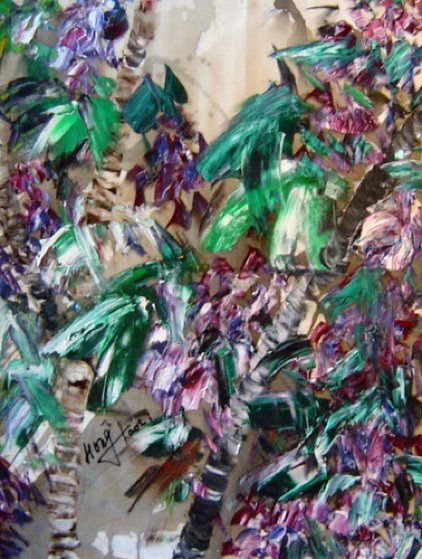
below is a short essay written as part of my work on abstraction in Chinese art and poetry
also in Chinese:
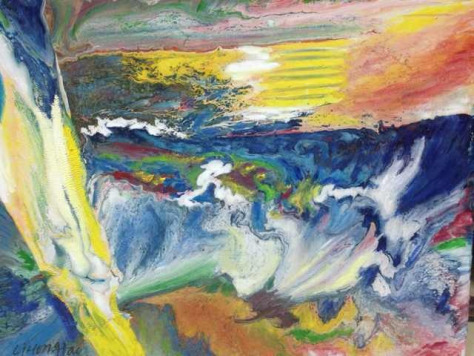
Abstract Healing of Li Hongtao
Li Hongtao was born in Dalian, China in 1947. He was not trained as an artist, having instead studied engineering, a career interrupted by personal tragedy–the loss of his father at a young age–and the collective catastrophe of the Cultural Revolution. After a brief engagement with culinary studies, Li took up visual art, a realm in which he is entirely self-taught. Nonetheless, in recent years he has established himself in major art networks, with solo exhibitions in Carlos Hall at the Louvre and the United Nations both in 2013, and numerous galleries and art institutions around the world.
Li’s paintings occasionally depict landscapes and other figures of usually natural rather than man-made origin, but by and large his work is done in a non-representational or abstract style. Though China certainly has a robust painting tradition stretching back centuries, and even a modern painting tradition based upon exogenous European examples from the 19th through 20th-centuries, the origins for abstract painting such as that produced by Li Hongtao are not in painting at all but in writing. This is because on a basic level the foundations of the Chinese writing system were at heart abstract, or better put, manifestations of “that which is of itself thus,” a paraphrase of the Chinese word “ziran” 自然 meaning nature. Chinese abstract art is by its very nature in line influential art critic Clement Greenberg’s view:
The avant-garde poet or artist tries in effect to imitate God by creating something valid solely on its own terms, in the way nature itself is valid, in the way a landscape–not its picture–is aesthetically valid; something given, increate, independent of meanings, similars or originals. Content is to be dissolved so completely into form that the work of art or literature cannot be reduced in whole or in part to anything not itself. (Art and Culture, Boston: Beacon, 1961: 6).
The Chinese writing system is derived, near as one can determine, from natural forms (li 理, or wenli 文理), patterns in bamboo leaves, landscapes, bird tracks or any other naturally occurring phenomena — all that is “aesthetically valid,” in Greenberg’s words, in and of itself. The hieroglyphic or pictographic stage followed from there, and the full Chinese character-based writing system soon after. Nonetheless, the abstract origin of all Chinese writing is ever-present for the calligrapher or artist to exploit, returning the word to the mere image, an object of contemplation in and of itself. Such was the case, for instance, in the work of Zhang Xu 张旭, Tang dynasty calligrapher who famously drank himself to a state of total inebriation and then produced wild, illegible but unanimously celebrated calligraphy. As a backdrop to abstract expression in China, there exists a rich array of examples from literature and art, a tradition which is, ironically, no less modern than anything produced in the West in the past two or three centuries.
Beyond mere mentions of style, Li’s work is connected with traditional Chinese painting in uncommonly substantive ways. To begin with, he draws clearly from Chinese landscape traditions. Namely, his visual forms can be appreciated not simply for the two dimensional attributes of lines upon on the canvas, but instead for their three-dimensional penetration of the space through shading and intensity of color, again much the way calligraphy is at least as much about depth or degree of saturation of black and white as any given stroke or line. We don’t look at Li’s painting, we look into it. In so doing, though, we are engaged with the work in a fashion that is unlike regular artistic observation or appreciation. Li’s painting is a demonstration in traditional Chinese aesthetic terms not of a given “expression” of an artist, but indeed, of the artist himself, his person, even his moral or spiritual being, a form of the ancient Chinese adage that “writing is the delineation of the mind” 书心画也 (attributed to Yang Xiong 杨雄–53–18ce).
But Li’s work is alternatively known as “energy painting,” something which takes us deeper in to his work still, and where he transcends the East-West and perhaps even figurative-abstract divides altogether. With his particular ability to draw from the power of color, Li himself sees his work not only as something which pleases, or even challenges his viewers. His goals as an artist are even more ambitious that then. He takes the interaction with his paintings as a form of reclaiming essential balance, a kind of cosmic order which, rather than remote and spiritual, from the Chinese view of health and wellness is simply a function of the flow of energy through the universe. This flow pervades the five elements of the natural world just as it does the vital organs of the human body, a material realm enlivened by qi 气, a primordial power or energy which travels the meridians in the human body (along with all other living beings), flowing either freely or with obstruction depending on the degree of health in a given organism. The viewer’s interaction with Li’s painting activates and stimulates this flow, images that can be not only seen but actually felt in the viewer’s body.
Li Hongtao’s painting is the kind of aesthetic accord which demonstrates that fully individual, even iconic work can flow seemingly effortlessly from two sources at once– a rich and ancient aesthetic tradition in China, a more recent, assertive avant-garde practice in the West. However, while looking at Li’s work none of these origin stories really matter much. The painting speaks for itself, louder than words could ever manage.
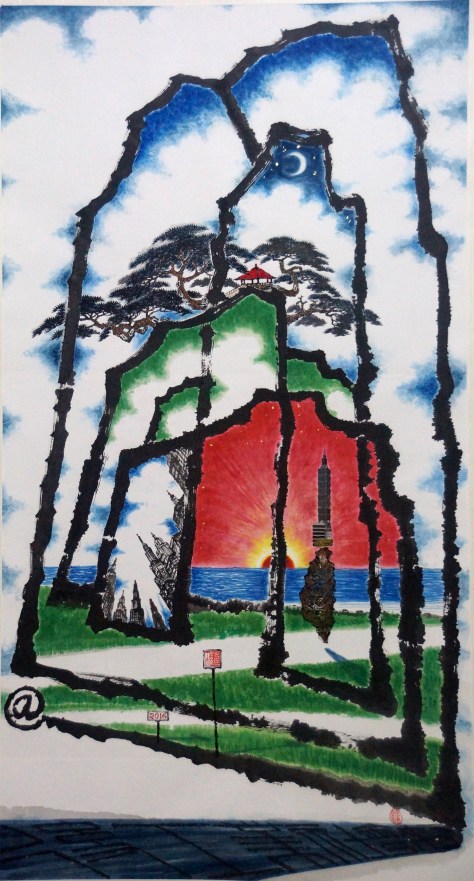
I’m taking this moment, after a few months reprieve from work on this blog, to announce the launch of the Ekphrastic Assimilations project. This will involve an exhibition, held at the VALA arts center in Redmond, WA and in conjunction with Ryan James Fine Arts in Kirkland, WA from September 15 through early November, as well as an academic conference to be held jointly by Pacific Lutheran University and the Seattle Asian Art Museum.
Please visit the website to learn more about the project, or check back here, where I will now be posting EA-related updates and information.
A new and better version of my Other Shore essay now up at MCLC
Many thanks of Kirk Denton for posting.
Sichuan painter Zhong Biao recently opened his third one-man exhibition in the United States, the first two having occurred in San Francisco at the Frey Norris Gallery in 2007 and 2011. This time his work is on view in New York courtesy of the Klein Sun Gallery (from Feb. 18 to March 19), in operation in its current 8,000-square-foot location in Chelsea since 2013. The gallery, which represents fifteen artists including the emerging ceramicist and multi-media artist Geng Xue 耿雪 as well as more established figures such as Cui Xiuwen 崔岫闻and Liu Bolin 刘勃麟, is one of the most dynamic outfits specializing in contemporary Chinese art in New York, if not the United States. Zhong Biao fits well within this pantheon, while a bit older than most of the others represented, his work continues to be fresh, exuberant, and even visually stunning.
The show’s title, “The Other Shore,” refers in part to geography, the typical configuration of which situates China on one side and “the West” on the other. This arrangement is operative in Zhong’s work even despite its obvious shortcomings. That “the West” is an entity at all, for instance, and in any case that “China” should be its counterweight, are both notions just about as questionable as they are frequently rehearsed. Zhong’s work actually invites such conceptual speciousness, and does so not in the fashion of artistic interrogation or even playfulness; his concepts are starting points from which he launches into something actually completely different. Nonetheless and in terms of geography, Zhong’s arrival after many years in New York is worth noting.
New York is, in one narrow sense, an “Other Shore” to Beijing where his own studio is located. Both are world centers, nodes of reference in our wide, amorphous arena known as the globe. For an artist, such nodes are less anchors than, again, points of departure. In an interview in mid 2015, when asked “Of all the cities in the world, in which would you choose to reside?” Zhong’s answer was:
New York, because the richness of this city brings with it a sense of security, a security that can fully accommodate my anxiety of choosing in the first place. This also illustrates the fact that ultimately, I have no idea what I really want from this life.[1]
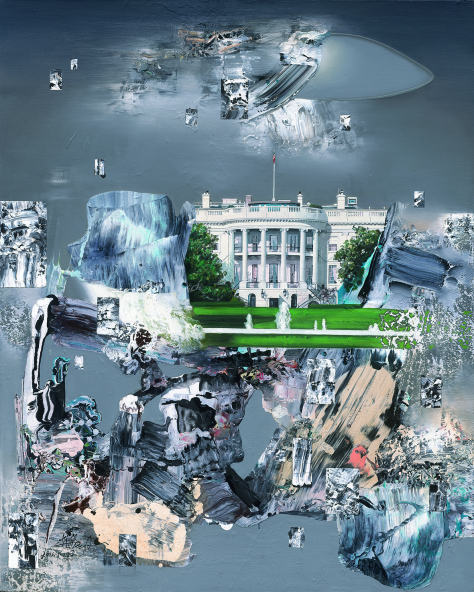
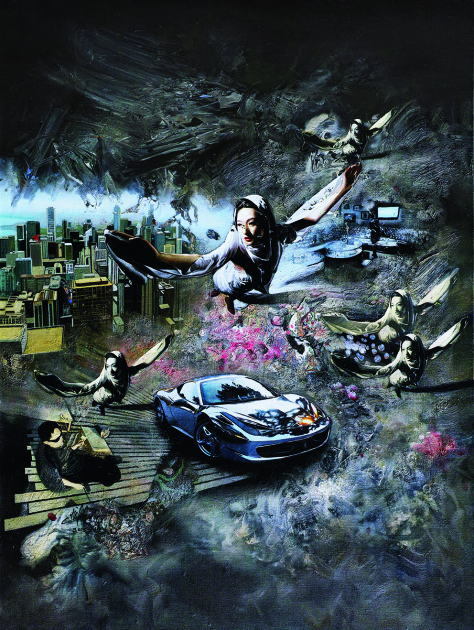
Cities like New York are like fuel for the engine driving artistic work, coalescences of source material that become paintings. In practice, this means that Zhong creates paintings from images he himself captures using his own digital camera or collects from any other print or digital media. The raw material of these images is then rendered and collaged by hand in oil paint or acrylic, generating images which traverse space and time while retaining a hyper-realist accuracy. Expanses of blue sky frame hairs on human flesh. Bodies, whether corpulent or lithe, old or young, are arrayed in environments built or natural, all painted in his signature minute detail. The scale of his paintings is also often very large, with his largest work — Mirage (2009) — reaching a width of fifteen meters. This scale enables viewers to travel from the quotidian to the cataclysmic and back again in the space of a single canvas. The scenes Zhong selects and then depicts are not random — they are resonate historical events, financial upheaval, political vicissitudes, scandal. These references serve to situate us as viewers securely in our present circumstances. House of Cards (2015), for instance, brings to mind the 2016 US presidential contest, and Chinese Dream (2014), is a reference to Xi Jinping’s optimistic if often derided slogan.
That said, to focus too narrowly on the thematic, symbolic, or referential elements of Zhong’s work is an interpretative misstep. The geographical or even thematic readings of Zhong’s “Other Shore” are therefore also limited. If there is one major theme which travels throughout his work, it is flight, whether of actual birds or of human figures in various states of levitation. The avian imagery carries with it its own set of symbolisms. Cranes – a symbol of longevity, among others –feature prominently in Zhong’s work, but we also see eagles, and even pigeons. The hawk in Take Off (2015), the Avalokiteshvara figure arising majestically out of Journey to the West, (2015), and the repeated image of a woman in flight seen throughout Velarium (2015), are prominent examples in this exhibition. But this is flight not entirely for its own sake. Zhong’s flight is part of a larger inclination, namely to transcend boundaries and constraining forces of almost any sort, beginning with gravity and moving on from there.
The connection with our present moment is studiously observed, and highly relevant, for therein lies part of the energy of Zhong’s work. But the energies are only observable in juxtaposition to one another. For example, in The Other Shore (2015), Palmyra, a recent casualty of ISIS aggression in Syria, occupies the upper right portion of the canvas. Palmyra is then balanced, upper-left, by the Tiger’s Nest Buddhist Temple (Paro Taktsang) in Bhutan, a seventeenth century structure built upon a mountain peak whose location has been a destination for Buddhist pilgrimage since the eight century. The center of the image, meanwhile, is the Gugenheim Museum in New York, a structure reflecting a different sort of history altogether. The three structures, all artifacts of human endeavor and ingenuity, are profoundly contrasting: one preserved for millennia only to be lost in an instant to seemingly senseless religious strife, another suspended upon a mountain peak against gravity and time, and a third in its ascendency, but with a future whose uncertainty is made clear by its contrast with the others. On closer examination, however, we see that such facile juxtapositions are not entirely what Zhong’s paintings are about. Contrasting elements are designed to reveal not the structures themselves, however meaningful they may appear, but instead underlying forces that generate or at least flow through all the material forms. This goal Zhong explained in an interview with Gao Minglu as far back as 2004:
I am always looking for an underlying or internal order driving events, and moreover attempting to use this order to comprise my own works. No matter if its ancient, modern, local, foreign, direct, indirect, whatever enters the ear, eye, mouth or heart, even if its source is gossip on the street, in the end all that can be perceived comprise the greater environment of our existence.[2]
With this decade-old quote in mind, we may move on to what is and what has been “The Other Shore” in Zhong’s work for a long time: time. For Zhong Biao the artist, it is the problem of depicting time that has preoccupied him from a young age. As he recalled during a recent speech given at an exhibition in Beijing, the facts that perception of an event, even one taking place directly in front of us, still occurs milliseconds after the end of the occurrence, or that the light we see coming from a distant planet actually appears to our eyes only thousands of years after the death of the planet, were entirely befuddling to him.[3] If, he continued in this speech, we consider time to be a cake, and we cut the cake in two, with the past on one side, and the future on the other, we find ourselves with nothing but a knife and a handful of emptiness.
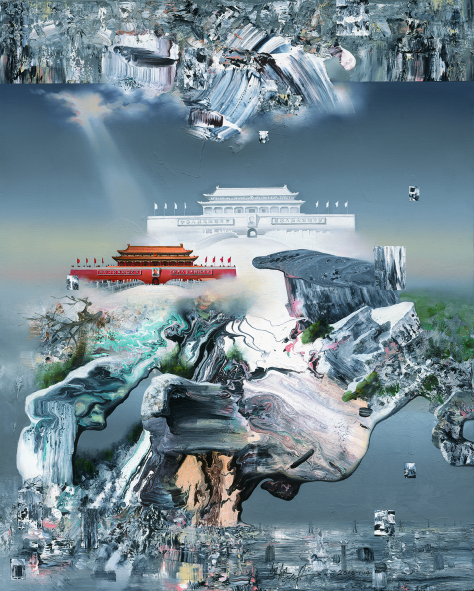
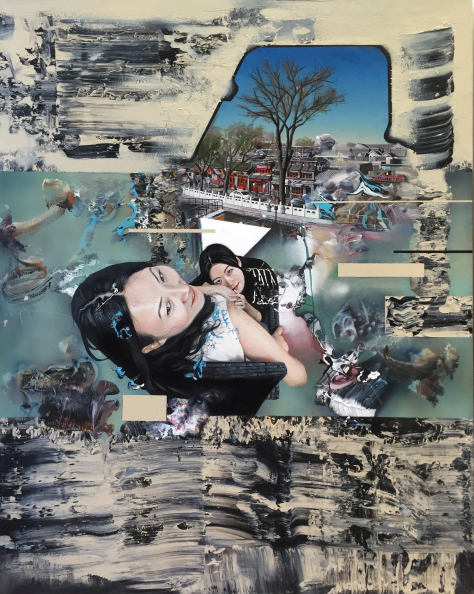
It is also this preoccupation with time that drove Zhong, around the year 2006, to include abstract images in his work. The abstract strokes are depictions of the forces that pervade our phenomenal world, ever-present and yet not confined to linear sequence of spatial reality. This abstract element has also evolved notably as well as subtly in his work over the years. In earlier paintings, there were smooth swaths of color, executed with large brushes in a balletic process (Zhong works with an assistant who helps him move large canvases up and down as he quite literally dances and paints in front of them, often with thunderous musical accompaniment). Those abstract forms were akin to the occasional video installations Zhong includes with his exhibitions, where hyperrealist images from paintings appear on a video screen, and then dissolve, with traces of recognizable figures giving way to completely abstract forms before reconstituting as new figures. More recently, the swaths have grown richer, more angular and three-dimensional, giving a sense of layered or parallel realities torn from one another, conjuring memory both recalled and ruptured. Houhai (2015) is an excellent example of the way Zhong now deftly weaves hyperrealism with complete abstraction, allowing him to challenge the limits of each in a single canvas.
In fact, the blend of figural and abstract is broadly emblematic of Zhong’s work, both as a painter and a thinker. His goal is to use painting, among other artistic media, to challenge the limits of space and time which frame both his art and our experience. [4] Not surprisingly, frames themselves are often the subject of his work.[5] Such aesthetic strategies are more than mere meditation on the function of art and our responses to it. Instead, addressing his medium while he works is part of Zhong’s push against our understanding of the phenomenal world itself. His clever juxtapositions of disparate thematic elements which seem to enliven our current affairs, whether by reminders of still resonate events in human history or reference to current preoccupations such as terrorism or environmental distress, are actually distractions from a deeper appreciation of the degree to which we as perceiving subjects are mere conduits for energies which at any particular intersection of materialized space and time manifest as “now.” Zhong’s work, in other words, points to a state of immense surrender, to a condition where our privileging of ourselves in the here and now dissipates in a cosmic flow both ancient and endless. This also generates the essential dissatisfaction with his work, an ongoing frustration with the gaps between perceived world and the true moment (当下) of our being. At least for the moment, this frustration has not translated into a withdrawal from painting itself. May that remain the case for at least a while to come.
Paul Manfredi
Pacific Lutheran University
[1] Bazaar Art and Fashion 芭莎艺术. “Artist Zhong Biao: Without Curiosity, There Is No Inspiration” (艺术家钟飙:不怀揣问号,还想泡灵感?). Interview, 25 Dec., 2015. Web.
[2] Quoted in Ubiquity: Zhong Biao’s Works (无处不在:钟飙作品) 1994-2004 (Shanghai: Artscene China, 2004), np.
[3] Zhong Biao. “Exhibition Closing Remarks,” Zhong Gallery 中画廊, Beijing. 15 Oct., 2015.
[4] Zhong has worked almost entirely in oil or acrylic paint, charcoal and other such material on canvas almost exclusively. The only outlying example is the 2011 Suzhou exhibition “Tailoring Clouds,” is a good example of such attempts. Unlike previous experiments, where video installations provided distillations of images he provides on canvas, “Tailoring Clouds” involved extensive installation of artifacts (burial stones, petrified rocks, miniature structures, 3d printers and more), a cohort of Zhong Biao-esque elements which actually demonstrated wide-ranging intellectual interests quite well.
[5] Zhong is fond of painting frames, which can be either paintings within paintings, or, as in the series from 2009, contrasting abstractions and frames (Invisible Possibilities 无形的可能性) for instance depicts frames within frames, in some cases including viewers observing the “canvases” from within the canvases,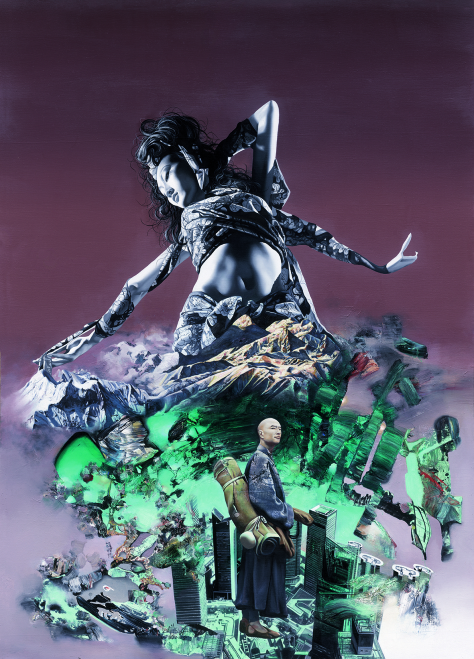
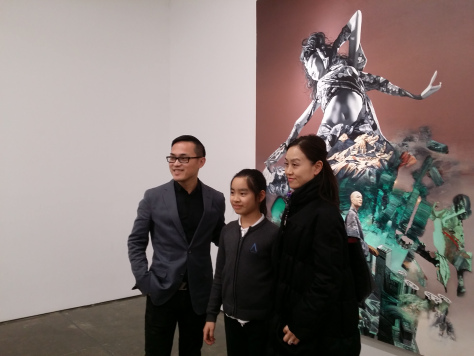
“The Other Shore” opening
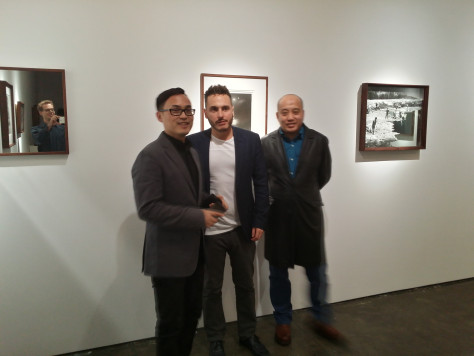
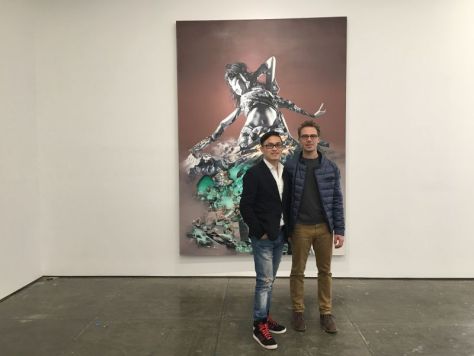
On view now is Zhong Biao’s exhibition “The Other Shore.” In addition, there is an annex featuring recent work collectively titled “Fountain” 泉 of photographer, installation artist 蔡东东 (pictured with gallerist Eli Klein and Zhong above). Below is the essay I wrote for the catalogue.
Zhong Biao: “The Other Shore”
Zhong Biao’s exhibition “The Other Shore” refers in part to geography, in which a typical configuration sees China on one side, and the West on the other. In the case of the present exhibition at Klein Sun Gallery, Zhong is making his first appearance in New York, the “Other Shore” being relative to Beijing. In fact, in an interview in mid 2015, when the artist Zhong Biao was asked the following question: “Of all the cities in the world, in which would you choose to reside?” Zhong’s answer was:
New York, because the richness of this city brings with it a sense of security, a security that can fully accommodate my anxiety of choosing in the first place. This also illustrates the fact that ultimately, I have no idea what I really want from this life.[1]
Zhong’s preference for such global urban centers is connected to his process as an artist. These are places where the concentration of human activity is high enough to provide sufficient material for his work. In practice, this means that Zhong Biao’s paintings are created from images he collects from his own digital camera or from other print or digital media. This raw material is then rendered and collaged by hand in oil paint or acrylic, generating images which traverse space and time while retaining a hyper-realist accuracy. Expanses of blue sky frame hairs on human flesh. Bodies, whether corpulent or lithe, old or young, are arrayed in environments built or natural, usually painted in minute detail. The scale of his paintings is often very large, with his largest work Mirage (2009) reaching a width of fifteen meters. This scale enables viewers to travel on foot a path which flows from the quotidian to the cataclysmic and back again in a single image. The scenes Zhong depicts are familiar – historical events, financial upheaval, political vicissitudes, scandal. These references serve to locate us as viewers in our present circumstances. House of Cards (2015), for instance, brings to mind the 2016 US presidential contest, and Chinese Dream (2014), a political slogan recently invented by current leader Xi Jinping, brings us to China’s rather extraordinary rise to prominence on the world stage today, both in its successes and its challenges.
That said, to focus too narrowly on the thematic, symbolic, or articulable elements of Zhong’s work is a misstep. The geographical reading of Zhong’s “Other Shore” is therefore also limited. If there is one major theme which travels throughout his work, it is flight, whether of actual birds or of human figures in various states of levitation. The avian imagery carries with it its own set of symbolisms. Cranes – a symbol of longevity, among others –feature prominently in Zhong’s work, but we also see eagles, and even pigeons. The hawk in Take Off (2015), the Avalokiteshvara figure arising majestically out of Journey to the West, (2015), and the repeated image of a woman in flight seen throughout Velarium (2015), are prominent examples in this exhibition.
Nonetheless, after spending some time pursuing the more recognizable features of Zhong’s repertoire, we notice that he’s not entirely interested in these elements anyway, except, to quote the title of an early 20th-century Chinese poem, as a sort of “organization of distances.” This organization is to a degree topical and connected to our present moment. For example, in The Other Shore (2015), Palmyra, a recent casualty of ISIS aggression in Syria, occupies the upper right portion of the canvas. However, on closer examination, we see that Zhong’s juxtapositions are designed to reveal underlying forces that generate or at least flow through all the material forms. We see in the first place a universal pneuma (or “qi” 气, in Chinese parlance) that propels all matter forward in time. From this space, in other words, we move on to what is really “The Other Shore” in Zhong’s work: time. To be more precise, it is the problem of depicting time that has preoccupied Zhong Biao from a young age. As he recalled during a recent speech given at an exhibition in Beijing, the fact that perception of an event, even one taking place directly in front of us, still occurs milliseconds after the end of the occurrence, or that the light we see coming from a distant planet actually appear to our eyes thousands of years after the death of the planet, were entirely befuddling to him.[2] If, he continued in this speech, we consider time to be a cake, and we cut the cake in two, with the past on one side, and the future on the other, we find ourselves with nothing but a knife and emptiness.
It is also this preoccupation with time that drove Zhong, around the year 2006, to include abstract images in his work. The abstract strokes are depictions of the forces that pervade our phenomenal world, ever-present and yet not confined to linear sequence of spatial reality. This abstract element has also evolved notably as well as subtly in his work over the years. In earlier paintings, there were smooth swaths of color, executed with large brushes in a balletic process (Zhong works with an assistant who helps him move large canvases up and down as he quite literally dances and paints in front of them, often with thunderous musical accompaniment), further punctuated by drips. Those abstract forms were akin to the occasional video installations Zhong includes with his exhibitions, where hyperrealist images from paintings appear on a video screen, and then dissolve, with traces of recognizable figures giving way to completely abstract forms before reconstituting as new figures. More recently, the swaths have grown richer, more angular and three-dimensional, giving a sense of layered or parallel realities torn from one another, conjuring memory both recalled and ruptured. Houhai (2015) is an excellent example of the way Zhong now deftly weaves hyperrealism with complete abstraction, allowing him to challenge the limits of each in a single canvas.
In fact, the blend of figural and abstract is broadly emblematic of Zhong’s work, both as a painter and a thinker. His goal is to use painting to challenge the limits of space and time which frame our experience. Whether or not launching such a challenge fully answers his question as to what he wants to do with his life is an open question. As he works towards an answer, we have plenty to look at in the meantime.
[1] Bazaar Art and Fashion 芭莎艺术. “Artist Zhong Biao: Without Curiosity, There Is No Inspiration” (艺术家钟飙:不怀揣问号,还想泡灵感?). Interview, 25 Dec., 2015. Web.
[2] Zhong Biao. “Exhibition Closing Remarks,” Zhong Gallery 中画廊, Beijing. 15 Oct., 2015.
Yi Sha TRAUM 553 eine phalanx nach der anderen papierso…
Source: TRÄUME VOM SEPTEMBER – Yi Sha 伊沙
